




They tell you why they came
A new member doesn't just create an account. During signup they say what they actually want — referrals, visibility, help promoting something, a seat at the table.


Members, sponsors, volunteers and past boards — one record of who they are, why they joined and what happened next. Segwik keeps it, so your staff doesn't have to.
Joining should be the beginning of a relationship, not the end of a transaction. Here are the four moments where a chamber either builds a record or loses one.

What brought you to the chamber?
Suggested introduction
Carlos asked for referrals. Marcus chairs Business Growth and knows four members who buy locally.
Members who need attention


A new member joins. Right now the chamber knows their name, their dues and nothing else.
A new member doesn't just create an account. During signup they say what they actually want — referrals, visibility, help promoting something, a seat at the table.
Segwik compares what the member said they came for with what every other member does and knows, so staff can make an introduction that lands instead of guessing from memory.
New members don't disappear into the alphabetical directory. Staff see who is on their first steps, who hasn't been contacted and what they asked for — before anyone follows up because they remembered to.
Requests, introductions, meetings, participation and follow-up become part of the relationship history. When renewal comes around, the conversation can be about what the chamber actually helped make happen.
The most valuable information in a chamber is rarely written down. It lives with the executive director, a longtime staff member, a board chair — or whoever happens to remember.
Nobody notices the member who joined in March and has spoken to no one since.
Decisions and promises live in one person's notebook, if anywhere.
The introduction only happens when the right two people are in the room.
Three members get asked twice, the rest never get asked at all.
When the director leaves, the chamber starts over. The relationships stay with the person, not with the organization.
The relationship layer matters because it's connected to the work: membership, events, payments, committees, communications and follow-up all live on the same member record. You can add that layer beside what you run today, or move the whole back office across.
Know who belongs, and where they are in the relationship.
Run the event without losing what happens around it.
Keep the work between meetings from disappearing.
Give every request somewhere to go.
Give members a front door that knows who they are.
Let the event end, not the relationship.
A payment is a transaction. An event registration is a transaction. Membership is a relationship — and it's the only one that has to be renewed.
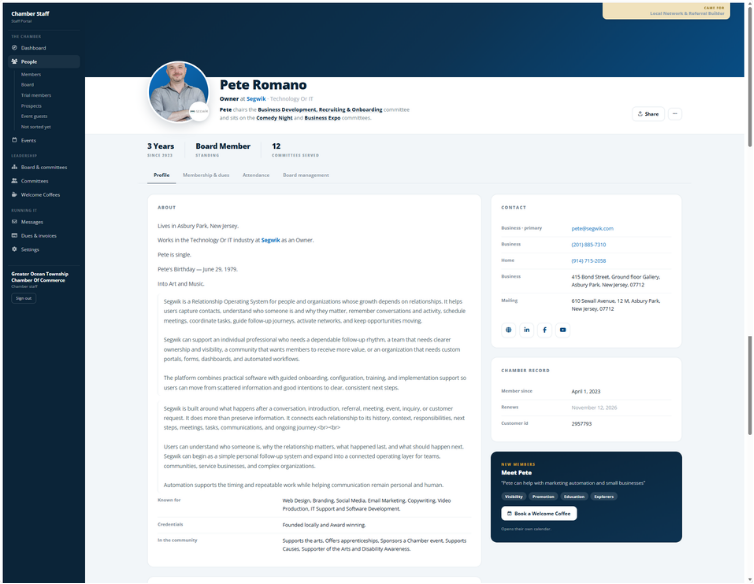
Screens from the Greater Ocean Township Chamber of Commerce, running on Segwik today.
A member record, including what they joined for.
Most chambers already run something for dues, events and the directory. Segwik doesn't require you to tear that out. Add the engagement layer your current system doesn't have, or move the whole back office across when you're ready.
Keep the system you already pay for. Segwik sits beside it and holds the relationship layer: why members joined, who they've met, what they asked for and what happens next.
Best when the back office works and the relationships are what keep slipping.
Run the whole chamber on Segwik — membership, events, payments, committees, communications and follow-up — with the relationship history built in rather than bolted on.
Best when the current stack is several tools that don't talk to each other.
Either way, you start with engagement. Replatforming is a choice, not a requirement.
A reminder with your name on it lands the same way every year. A record of what the chamber helped make happen is a different conversation.
"Your membership is up for renewal."
"You joined to meet more local business owners. Here's what happened this year."
And when the board asks what membership delivers, you have more than a member count.
Every chamber runs a little differently. Answer three questions and we'll show you where a shared record would change the work first.
How many members do you have?
How many people run it day to day?
What slips through first?
Your systems should help. Show us how your chamber works today, and we'll show you the version where the record stays with the chamber.