
Sarah ChenChen Architecture
Joined to build relationships with local developers
Not as separate pieces of Chamber activity — as one connected operating system built around the people your Chamber serves.
Joined to build relationships with local developers
This is an illustrative journey, but the point is practical: the things a Chamber does for a member can remain connected to the relationship instead of becoming separate pieces of activity.
Sarah Chen · Chen Architecture
“I want to build relationships with local developers and commercial property owners.”


“I'm looking for someone familiar with municipal permitting for a commercial project.”
Introductions · participation · member request · follow-up
Check in on connections and identify the next useful step
Sarah sees a Chamber that knows her. Staff need something different: a clear view of the work happening across hundreds or thousands of relationships.
Staff need to see what needs attention, who owns it, where members are in their journey, and what is happening across the Chamber.
Pick any piece of Chamber work and see what it leaves behind on the relationship.
People and the organizations they represent, connected.
Membership activity connected to the member.
Participation stays part of the member story.
People, participation and work around Chamber groups.
A clear path to ask, and a visible response.
Relevant communication connected to the people it's for.
Ownership and next steps, visible across the team.
A place for members to take part in the Chamber.
Screens from the Greater Ocean Township Chamber of Commerce, running on Segwik.
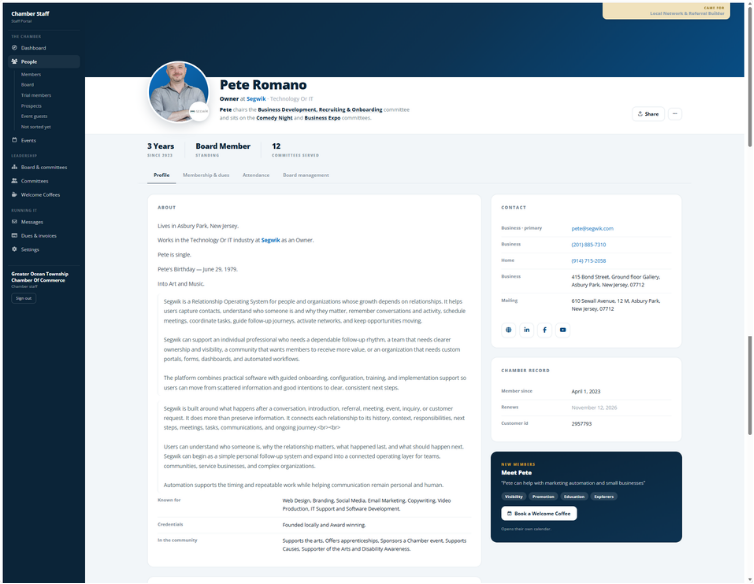
A member record, including what they came for.
Everything you just watched — the introduction, the request, the follow-up landing on one record — can run beside the system your Chamber already uses. Or it can be the system.
Your dues, events and directory stay where they are. Segwik runs the engagement layer: the member record, the introductions, the requests and who owns what happens next.
Best when the back office is fine and the relationship work is what disappears.
Run the whole Chamber on Segwik, so the work and the relationship record are the same system rather than two that have to be kept in step.
Best when the current stack is several tools that don't talk to each other.
Either way, you start with engagement. Replatforming is a choice, not a requirement.
A member joins, registers, asks, meets, participates or pays.
The Chamber learns more about the person and their needs.
Someone can see what should happen and who owns it.
The next conversation builds on what happened.
The same question, asked about your own Chamber: what only one person knows, and what happens when they are not there.
Show us how your Chamber actually works, and we'll show you what those same relationships and workflows could look like with Segwik behind them.
A practical conversation about your Chamber, your members, and the way your team actually works.
